
Output 30—What I (RE)Learned at Camp
Camp John Waters, that is. I’ve been mulling over why it was so good for me (thank gawd I didn’t heed those strong “feelings” telling me to cancel), and I’ve come up with a couple of things (as I “rest” with Covid I ain’t got energy to do much besides naval-gaze)...
First, the aforementioned “first day of college do-over.” Having the confidence to put myself in front of strangers as a creative person worthy to share their company is something I rarely do, at least not without first publicly stipulating that I am obviously only a cockroach in the company of peacocks, in order to avoid having to actually justify my presence. My tendency to do this to myself was instantly squelched by my fellow Campers, probably because they were on to me, probably because they had at some point in their lives, before finding the “tribe” that supported them, done it to themselves. At least internally.
And second, and probably equally as important as recovering the ability to exist with confidence in a group of artists, is that the people I met there, and the follow-up I’ve done since meeting them, brings me to a conclusion that has never even occurred to me before: That my initial acquaintance with the work of some of the people in this world gave me ideas about art at a time when I had been rejected as a traditional artist, and that those ideas were correct, and had I had the confidence, or the relationship with my brain that was required to produce work from ideas, I would have been on the right path.
Coulda woulda shoulda. Maybe that sounds sad—the fact that I didn’t trust my own ideas about art or my ability to produce that kind of art, and therefore only followed them as an observer. I missed so many opportunities by not trusting my gut, just like I missed so many opportunities because I hated myself too much to take my place with other artists.
But it’s also a massive realization because I have dismissed nearly every idea I’ve ever had as not worthy to follow through on (for all the reasons that led me to therapy now). And they were good ideas. They were the right ideas for me.
What the fuck am I talking about? Namely, “Pranks" as art. The immediacy of a well-planned action that plays with perception and misdirection, that shatters consensus reality when the prank is revealed, that uses the “press” and the “entertainment media” as unwilling participants to reveal the secret agenda of Capitalism and the dangers of conformity.
I was rejected from the “art” program at Bennington almost immediately because I had “no artistic integrity.” I produced underconfident figurative art. With some encouragement, I could probably have found a way to use it to put forward ideas (Pop Surrealism was just around the corner as a movement), but Bennington’s art faculty were slaves to the abstract art of Frankenthaler and the metal sculpture of Sera (both of whom taught there, not coincidentally). I didn’t understand that stuff, I had zero foundation in art history. I didn’t even know enough to know that it was NOT the only legitimate (perhaps then it was just the most marketable) form of art.
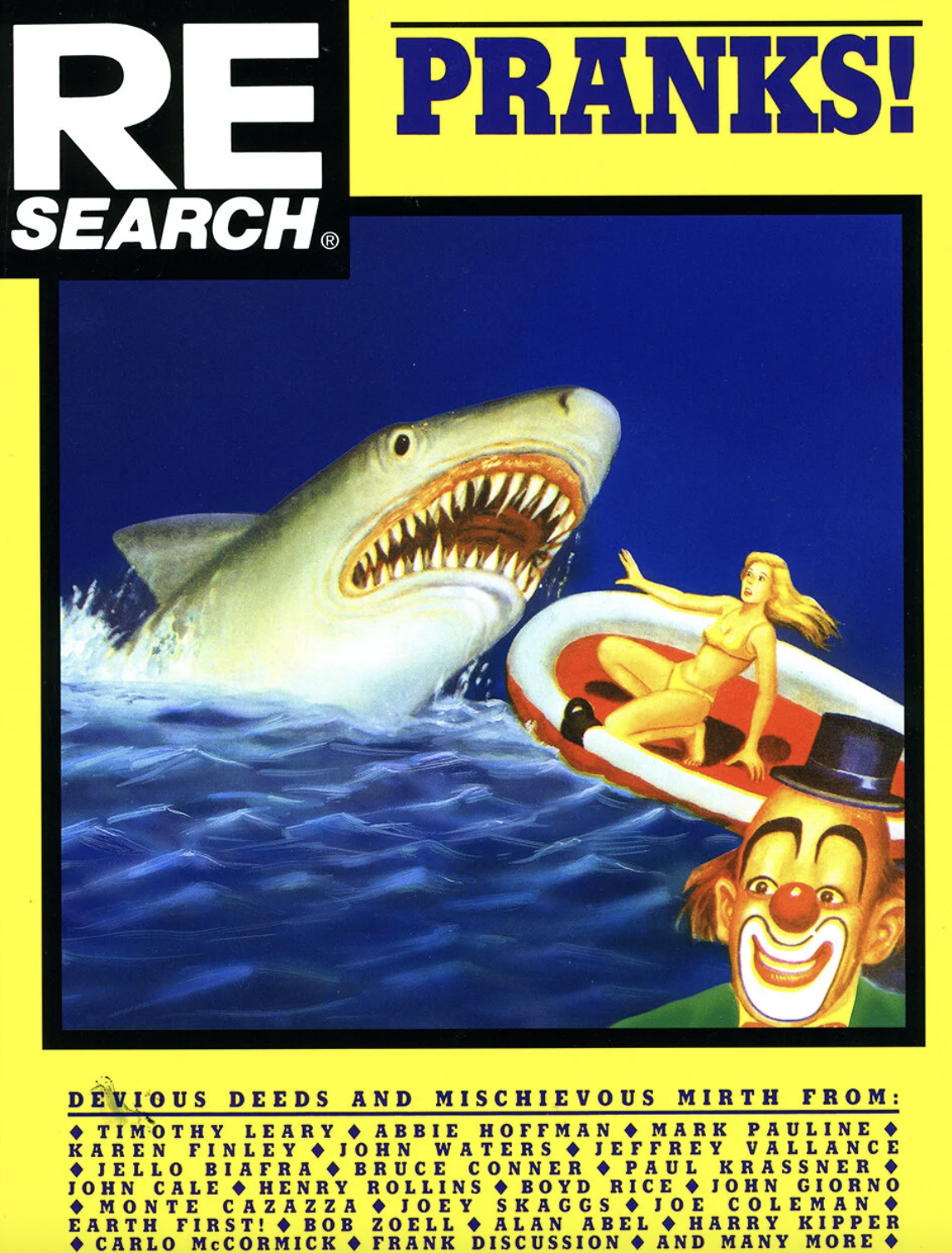
I remember my friend Nick Scheer, who liked to “blow shit up” (he was a science major) prodding me to go see a short film with him at the campus student theater, a half-hour short featuring an artist he loved named Mark Pauline who built the original “battle bots” with his San Fancisco collective Survival Research Labortories. I went with him because I’d never seen Nick enthused about art before and I loved his crazy vibe (and we shared a love for early industrial metal that other students weren’t into). The short was called PRANKS! (You can still find it on YouTube—bad transfer but WATCH IT!) and it was distributed as a companion piece to the book of the same name, published by RE/Search, also out of SF.
I loved the destruction of SRL’s infernal machines but was more impressed with Pauline’s early “billboard modifications,” where he would find a particularly idiotic advertisement that only needed a few “tweaks” to reveal the true agenda of the advertiser, he’d put on some coveralls, he’d get a print shop employee he knew to surreptitiously print some to-scale items, and then he’d paste over the billboard until its essential nature was revealed.
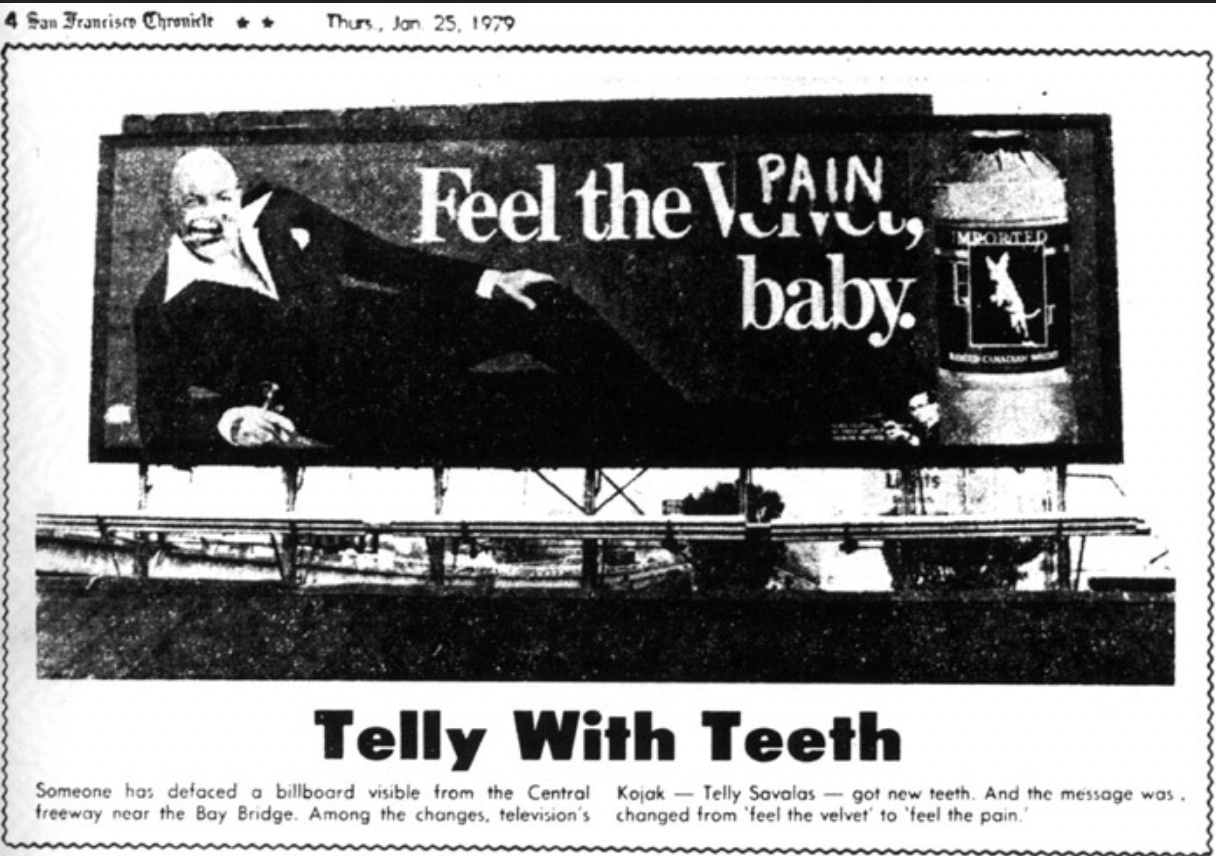
Everything about this appealed to me. It was cheap. It was funny. It was sneaky. It delivered a necessary message that many would find incomprehensible. It utilized an unwitting media to spread its message.
Others appearing in the short included Karen Finley, who was at the heart of the NEA funding scandals of the early 80s (remember? remember? THIS IS NOT THE FIRST TIME!), Frank Discussion, a punk singer who seemed kind of like an asshat to me (punching down, maybe a sociopath for real), Boyd Rice, who I think did turn out to be a bit of a sociopath but I sure as shit can’t tell if he really did “go Nazi.” He was, for me, a predecessor to Fred Armisen, who I worked with a bit in his early days in Chicago and who scared me to death because as funny as he was, he really didn’t mind breaking ALL THE EGGS (including friendships) to get the most potent laughs. In any case, some of Boyd Rice’s described pranks were juvenile but so hilarious I never forgot them.
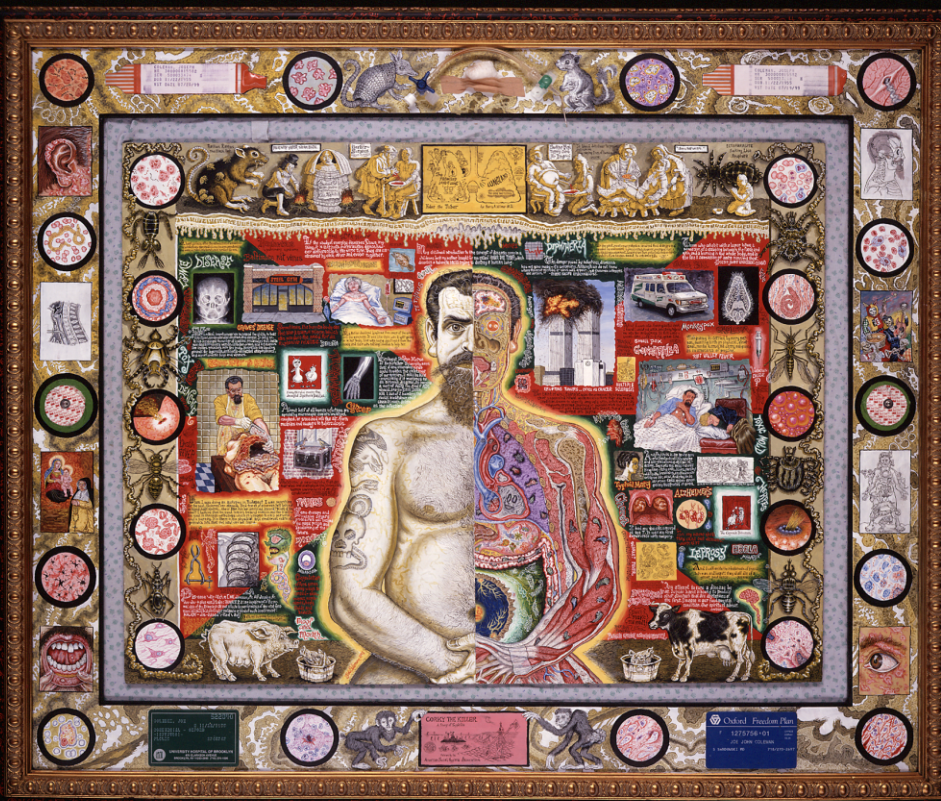
And then there was Joe Coleman. In PRANKS!, the focus was on his guerrilla “performances” where he’d show up at an art opening with a shotgun and firecrackers strapped to his chest. But they also mentioned his paintings, which were portraits (the only things I did well) on …acid? Doubtful. He said if it wasn’t for art he would have been a serial killer. I have a feeling that’s hyperbole. But I’ve followed Coleman every since, into the world of oddities and Coney Island and freaks and gaffes and pickled punks and… all of it. I love all of it. If only from a distance.
IN ANY CASE.
For me, in those years, this kind of art: public, misdirective, performative, shocking, reality-rending… that was the art that mattered. After seeing the movie and reading the book, I did some minor pranks around campus my Senior year—bumper sticker modifications, acid-fueled doorknob ties, Weekly World News cover mods featuring paste-ins of the college President’s face… etc.
But then I moved to Chicago, became a full-time drunk, and got sucked into a personal hell. I think my last “prank” was a modified alumni-fund solicitation that these days probably would get the FBI called on me. But by the time I had to start focusing on cleaning up my life, the idea of being an artist, especially in a place as intimidating as Chicago, ebbed away. My interest never did (loved ADBUSTERS, loved the Yes Men). But I didn’t trust that I was on the right track, I didn’t have the confidence to seek out people with similar interests, and I didn’t have the wherewithal to “go bigger."
Why did Camp bring up these ruminations? Not only was Camp (and most John Waters films, really) essentially a big prank, almost everyone there was a walking performance, in the best possible way. I met people who are part of the same Coney Island world that includes Joe Coleman. I actually met a few of my heroes at Camp. And I became one of them, because we were like one, big, filthy, beautiful body encouraging each other to bring our best ideas.
I do feel sad that I never had the confidence to believe that my instincts about art were right. That I’m not a “bad” artist with nothing to say. I just never allowed myself the grace of self-belief.
I don’t know how the path of PRANKS! can be followed these days. Part of the point of this approach to art is to use existing media to subvert expectations and beliefs and to sow the chaos that makes the viewer or participant doubt their version or reality long enough that a chink of truth might penetrate. But, this is always done (if it’s a good, worthy prank performance) in the service of TRUTH or, sometimes, VENGEANCE (against the cynical perpetrators of mis-truth).
Hail Eris! unfortunately, chaos has been harnessed by liars who are using “alternative facts” to create a false “reality” that only makes more room for them to amass great wealth at the expense of those who are too blinded by fear to see what’s happening. When the power of the Prank has been co-opted by people like Trump and Musk, how do GOOD people, the artists who actually think humanity is worth saving, take back that power? When the media is now routinely used to spread lies (when Joey Skaggs was in his heyday you could FOOL the media. Now the media is purposely FOOLING us, constantly! And knowingly!), what is the position of the artist who wants to use it to inject poetic truth into this morass?
I honestly have no clue. But the resurgence of this direct-action art occurred and flourished during the days of Nixon and later, Reagan and Thatcher. And the Dada movement, which emerged in the chaos of between-Wars Europe, is what brought this “attitude” into the world as “art.” So there MUST be a way.
I’ll be looking for it. I’m so grateful to Camp John Waters and the people I met there for bringing me back to my instincts and letting me know they, not Bennington’s myopic art faculty, were right all along.